Showing posts with label faith. Show all posts

3.10.2011

Catalyst West: Andy Stanley

imageThe first speaker at Catalyst West Coast this year was Andy Stanley.  The theme of the conference was “Take Courage,” and he admitted resisting the temptation to preach a sermon encouraging us to be brave like David or Gideon or Noah.  While sermons along those lines have truth in them, it can be a challenge to relate to them when the chances of you having an army you need to whittle down to the faithful few are pretty small.  There’s also the fact that if you’ve been around church long at all, you’ve heard plenty of sermons like that.  Andy took a different route, and I’m glad he did.

Before he got into his message, though, I could tell he was bugged by the inability of this room full of alleged adults to control themselves with the little poppy things we’d been given.  You remember those little boxes from when you were a kid – they were full of little bags of powder or something that would *bang* when you threw them at the ground?  Somebody thought it would be a good idea to put one of those boxes under each seat.  So many people couldn’t help themselves and kept messing with them long beyond the time they should’ve been.  I found Stanley’s lack of amusement with them amusing.  And he was right on.  Anyway.

Here are a few of the highlights I got from his message:

The person engaging in an act of courage usually has no idea what the ramifications or impact of that decision will be.  We’re not living in movies, and the orchestra doesn’t tense up when we’re about to make a climactic choice.  We go through life and make the choices we’re presented with.  Some have big impact and others little – but we don’t know which is which. 

While our stories aren’t likely to be on the front page of the newspaper, we’ll face moments/opportunities/challenges that will require us to exercise the extraordinary courage we so often shrink from.

He then went on to describe three (he said four but ran out of time) faces of courage – times when courage may be required for us to move forward into God’s best plan for our life.

One of those situations was having the courage to ask for help when it would be easier to pretend that everything’s okay.  The secrets you have influence the way you lead.  You compensate for your secrets in ways you don’t notice but the others around you do.  He called those who needed help but didn’t get it chickens. 

We don’t ask for help because we’re afraid of what others might find out about us, or what we might discover about ourselves.  But the real thing we need to fear, according to Stanley, is waking up one day and realizing we are outside of God’s will for our lives.  If we are to lead, we need confidence that God is with us.  If I’m not confident I’m where God wants me to be, how am I going to lead with confidence?

Do I fear being out of God’s will more than poverty?  Irrelevance?  The opinions of others?

I think what stuck with me most from his talk was something he said toward the end:

One day, everything I’m going through right now will just be a story.  All the stresses, pressure, hopes, worries, doubts, fears, responsibilities – all of it will be a story.  When this chapter of my life is over, what story do I want to tell about it?

“It would’ve been easier to X, so I did.”

“I was afraid of Y, so I didn’t.”

For some reason that really resonated with me.  I can think back to so many situations and times in my life where I was consumed with one thing or another, worrying about this decision or that decision – and now they’re stories.  I wonder how many stories I missed out on because I wussed out?  I do not want to wuss out.  I want my greatest fear to be that I’m out of God’s will for my life.  I’m not sure it is.  But I want it to be, and I will be praying for God to make it so.

3.26.2009

Stupid Things “Christian” Kids Say

Today at lunch I was sitting in class listening to the Gay Straight Alliance meeting.  They were a bit upset because the club apparently has some lack of direction so they got to discussing what they see as some of the biggest issues on campus they could try to address.  I paid extra attention to listen to what they brought up and the results were unsurprising but disappointing nonetheless.

The first girl to speak said she was having some trouble with something her best friend said.  She was vague at first about what her friend had said and just remarked that she wished her friend would have worded it differently.  The club president pushed a bit to hear what exactly her friend had said.  The girl started with “Well, she’s very religious, Christian.”  The response was a chorus of understanding “ooohhhhs” and an “enough said.”

When pressed further she revealed that her Christian friend said “why should I care about homosexuals when they’re all going to burn in hell anyway?”

Who the crap is raising their kids to talk this way?  The next thing the girl said about her friend sounded a lot more like something you’d hear out of Jesus’ mouth than what the supposedly Christian kid said:

“It’s okay if she believes something different.  I mean, I don’t like it but I need to accept that about her and be her friend.  That’s what this club is about – acceptance.  So I know I need to accept her.  I just wish she would have used different words.”

I know I butcher the message of Jesus in my daily life plenty to others and I do plenty of harm to the gospel with my actions.  I can sit in judgment of no one.  But I think the first girl is closer to the heart of Jesus than the one who wears the Christian label. 

How sad that a club trying to stand up for a group that often gets made fun of and ostracized has this experience with Christians.  How sad that we followers of Christ are not known for our love but instead for our hatreds.

3.18.2009

Sermon / Podcast Recommendation

image This won’t be useful to many of you but some of you should appreciate it.  I’m always on the lookout for good podcasts to listen to while I’m driving or working out.  Many churches are now podcasting their sermons.  I wanted to recommend one particular sermon podcast to those of you who might benefit from such a thing – that of the Village Church in Texas.  Matt Chandler is their lead pastor and the guy who preaches most of the time, but I’ve heard one sermon from another guy and enjoyed what he had to say too.

They’re a Reformed church and I’m not Reformed (that means they believe in Predestination and are Calvinist) but I still greatly enjoy the preaching and think it is some of the best I’ve heard.  The focus on God’s grace, preaching the Gospel, and the lack of moralism is awesome.  It enriches me and if you’re looking for something worthwhile to listen to on your mp3 player give it a try. 

Following this link will take you to the Sermons page where you can download them individually, subscribe to the podcast, and even get study guides related to each of the sermons.  If you do a search in the iTunes store for “The Village Podcast” or “Matt Chandler The Village” you should find the podcast and be able to subscribe to it.

12.02.2008

A.W. Tozer on Pride

I want to share a passage I read a while ago that’s always stuck with me when I think about the issue of pride.  In Matthew 11.28-30, Jesus says this:

Come to me, all you who are weary and burdened, and I will give you rest.  Take my yoke upon you and learn from me, for I am gentle and humble in heart, and you will find rest for your souls.  For my yoke is easy and my burden is light.” – Matthew 11.28-30 (NIV)

image What follows here is part of A.W. Tozer’s great work The Pursuit of God, where he discusses a bit of what he thinks Jesus means when referring to the burdens we carry around.  This is one of my go-to passages when I’m thinking about pride:

The burden borne by mankind is a heavy and a crushing thing.  The word Jesus used means "a load carried or toil borne to the point of exhaustion."  Rest is simply release from that burden.  It is not something we do; it is what comes to use when we cease to do.  His own meekness, that is the rest.

Let us examine our burden.  It is altogether an interior one.  It attacks the heart and the mind and reaches the body only from within.  First, there is the burden of pride.  The labor of self-love is a heavy one indeed.  Think for yourself whether much of your sorrow has not arisen from someone speaking slightingly of you.  As long as you set yourself up as a little god to which you must be loyal there will be those who delight to offer affront to your idol.  How then can you hope to have inward peace?  The heart's fierce effort to protect itself from every slight, to shield its touchy honor from the bad opinion of friend and enemy, will never let the mind have rest.  Continue this fight through the years and the burden will become intolerable.  Yet the sons of earth are carrying this burden continually, challenging every word spoken against them, cringin under every criticism, smarting under each fancied slight, tossing sleepless if another is preferred before them. 

Such a burden as this is not necessary to bear.  Jesus calls us to His rest, and meekness is His method.  The meek man cares not at all who is greater than he, for he has long ago decided that the esteem of the world is not worth the effort.  He develops toward himself a kindly sense of humor and learns to say, "Oh, so you have been overlooked?  They have placed someone else before you?  They ahve whispered that you are pretty small stuff after all?  And now you feel hurt because the world is saying about you the very things you have been saying about yourself?  Only yesterday you were telling God that you were nothing, a mere worm of the dust.  Where is your consistency?  Come on, humble yourself and cease to care what men think."

The meek man is not a human mouse afflicted with a sense of his own inferiority.  Rather, he may be in his moral life as bold as a lion and as strong as Samson; but he has stopped being fooled about himself.  He has accepted God's estimate of his own life.  He knows he is as weak and helpless as God has declared him to be, but paradoxically, he knows at the same time that he is, in the sight of God, more important than angels.  In himself, nothing; in God, everything.  That is his motto.  He knows well that the world will never see him as God sees him and he has stopped caring.  He rests perfectly content to allow God to place His own values.  He will be patient to wait for the day when everything will get its own price tag and real worth will come into its own.  Then the righteousness shall shine forth in the kingdom of their Father.  He is willing to wait for that day.

In the meantime, he will have attained a place of soul rest.  As he walks on in meekness he will be happy to let God defend him.  The old struggle to defend himself is over.  He has found the peace which meekness brings."

- A.W. Tozer, The Pursuit of God

11.23.2008

The Lens of Faith, Part Three (The End)

This is the third of three posts – read post one and post two for context.

image While faith must be grounded in reason and is not just wishful thinking, there is also a certain amount of choice involved.  People must reach conclusions of their own regarding what is or is not too big of a leap of faith.  I want to believe what is true, not just what makes me feel good.  If I simply wanted to believe something to make me feel good I would not subscribe to Christianity.  I follow Jesus because I believe He is the real deal.  Some beliefs I hold more strongly than others.  For example, it is central to my belief in Jesus that He is not simply a good teacher but is God incarnate, a member of the Trinity.  It is also central to my belief in Him that He lived a perfect, sinless life and died on the cross as payment for the sins of all humanity.  I believe those things strongly because I believe they are clearly laid-out in Scripture and a coherent picture of Jesus drawn from Scripture must, I believe, include those things.  Other beliefs about God and what He does on Earth are less well-defined and more up for debate and interpretation.

For example – the Bible says:

Every good and perfect gift is from above, coming down from the Father of the heavenly lights, who does not change like shifting shadows.” – James 1.17 (NIV)

That seems straightforward-ish, but how do I identify what a gift is and what a coincidence is?  Is every good thing that happens a gift?  What about things that may be good but I interpret them as bad?  These are the kinds of decisions we have to make – how are we going to view the world?  Because I tend to view the world as a critical thinker I am very slow to attribute something to the work of God unless I feel like I have a really good reason to do so.  But is there any harm in attributing something to God when He didn’t do it?

For example – the person who thanks God for the good parking space – what harm is there in that?  What does it matter if someone wants to believe God orchestrated events so they could walk twenty less feet to go into the mall and buy crap they don’t need?  I think it can be harmful or counterproductive in a couple ways. 

First, I would argue the harm is not in that particular instance – and perhaps that little incident would “grow” their faith or make them think more about God – but I think that sort of stuff breeds a dangerous kind of credulity that makes the person vulnerable.  If someone simply claims God is responsible for various things but doesn’t put much thought into which things, how likely are they to simply believe someone who comes along and says “God told me you need to give me this” or “This is a movement of the Spirit and you should be involved?”  If you have no filter or method or criteria for determining what you think God does and does not do when it comes to things in your own life (like parking spaces) then how much more likely are you to simply accept what someone else says?  If no amount of thinking or evidence or reason can be applied, and everything is simply “faith,” then I think you are entering dangerous territory.

image A second way I think thanking God for the parking space could be harmful is the fact that it may encourage a kind of solipsistic faith.  What I mean by that is a faith that thinks mostly about the self and how God makes your life better.  It is the kind of faith that misses the point of the gospel and turns Jesus dying on the cross for our sins to inaugurate the coming of God’s Kingdom to earth into Jesus dying on the cross so we can have nice things and go to heaven when we die.  This kind of viewpoint on faith can give rise to the kind of person who prays for God to “deliver” them from the struggle of having to rent instead of buy, while they rack up credit card bills buying crap they don’t need and say they can’t afford to give money to charity or the church.  It can lead to the kind of vapid faith that so many outside Christendom find hollow and so many (not enough) within find revolting at best

So what am I to do when I look at the circumstance I find myself in?  I’m pursuing a career path that fell into my lap, that’s not what I originally wanted to pursue.  If I had been left to my own devices and this teaching thing not come along, my family would almost certainly be in a worse place. 

I’ve decided this is an example of God providing for me and giving me a gift.  Why this and not a parking space?  I can’t exactly list the reasons.  But this feels more important to me than a parking space.  And I think I will be better for the gospel and my family will be better for it with this new path.  Am I 100% positive God brought me this new career and directed me away from the corporate world?  No, but I think He did.  And I don’t think by praising God for it I am falling into the trap I’ve described.  Yes, it’s possible this was just coincidence and not a result of God’s providence; but if I can’t thank God for this, I can’t thank Him for anything. 

So I suppose to one extent this is part of what “faith” means for me: being willing to thank God for something even if I have to exercise some faith in believing He brought it to me rather than me being brilliant or lucky.  It’s a pretty meager definition of faith by the standards of some, but it’s where I am at the moment.  In truth, everything I have

I think I need to perhaps be a bit less judgmental of people who have a less skeptical mindset than I do.  Some people rail against athletes who thank God for their success, or people who thank Jesus for winning an award.  Critics think it’s stupid of the person to think the God of the Universe would care who wins the Superbowl or who wins the MVP award.  To them it smacks of the egotistical, “me-focused” faith I described earlier.  I can see that, but I think understood the way I am talking about here it doesn’t have to be ridiculous.  If you believe God provided you with the talent you used to win the game, why would it be inappropriate to thank Him when image you win?  It’s not the same as saying He made you win the Superbowl – but it’s recognizing you have been blessed with opportunities and gifts and whatever else that others don’t have.  Two people making the same statement – “thank God” – can be communicating very different sentiments and thought processes.  I think one person making the statement could be making an admirable, humble statement and someone else making it could be saying something incredibly stupid and self-centered.

I still think it’s dangerous to place your faith on shaky ground or to look at the world from an “I believe everything I hear even if there’s no evidence presented” point of view – but for me to look down on others with that mindset is prideful and I don’t think very Christ-like. 

While it is less likely I will be fooled by errant theology or charlatans, it is also less likely I will notice the ways God lavishes His love upon me.  It is likely I will not notice and be thankful for the true blessings in my life.  I still can’t bring myself to thank God for giving me a green light or a good parking space – but I feel safe thanking Him for growing up where I did, for my natural abilities, my career, my home, my friends, and my family.  I suppose it could have all been dumb luck, but I don’t think it was.

11.22.2008

The Lens of Faith, Part Two

In my previous post I set the stage for this post, so if you haven’t read it (and you want to understand what’s going on here), you should read it.

My faith has come a long way over the years and it is still evolving.  The relationship between “faith” and what I call my skepticism or critical thinking isn’t always clear-cut.  (As an aside – I would encourage you to read this article on the nature of faith by Greg Koukl – it helps you understand what I mean when I use the word.)  Sometimes I don’t know how to interpret the things that come my way.

image I don’t believe faith is just wishful thinking – it should have some foundation in fact.  If I have no good reason to place my faith in something or someone, I don’t do it.  I find no nobility in believing something in spite of evidence or in the face of no evidence.  When someone tells me something that they believe, I want to hear why they believe it.  But when I think through the various events of my life, or different things that happen, I’m not always sure what to believe. 

The whole thing that prompted these two posts is my current job situation.  At the beginning of 2008 I decided to no longer pursue ministry as my full-time career.  At first my goal was to find a job in some kind of HR position.  I thought I didn’t want to be a teacher.  I applied to dozens of jobs – probably around a hundred – in the HR field.  For months, beginning in late 2007, I applied to all manner of companies, from Google to Safeway to places I’d never heard of.  At first I only applied to jobs I liked the description of but later I became less discriminating.  I had one interview for a job with a NASA contractor in Mountain View but was the “runner-up” for the position.  I received a phone call during the last week of January asking if I wanted to take a long-term sub position at Washington High School beginning the next week.  Having previously decided I did not want to enter teaching as a career, I figured this would at least be consistent work while I looked for an HR position.

This “sub” job changed the course of my job search.  Upon my arrival a few days after the call, I was informed that I would in fact be the teacher.  On my first day I told them I wasn’t really planning on becoming a teacher so I’d let them know if I wanted to commit to the whole semester.  After three days with the students, I knew teaching was the right career for me.  I enrolled in a teacher credential program, threw myself into the job, and had a great (and exhausting) semester.  I’d found the right career.  Or perhaps more accurately, the right career found me.

Last week I was listening to the zillionth news report on our economic woes, on the tens of thousands of layoffs, and realized something.  If I’d gotten into the HR field I would likely have already received a pink slip.  As a newbie in that field I would probably be among the first to go when the cuts came – and they are coming.  Right now our financial situation isn’t spectacular – Janelle is student teaching (making no money) and I’m subbing and tutoring to make money.  We’ve taken out gobs of student loans (thankfully that is our only debt) to pay for our credential programs, and we will be trying to find teaching jobs in a district that is facing millions of dollars of cuts next year – but we are in a far better place than we would have been if I were an HR mook somewhere.  How did I get this job and get put on this path I didn’t even know I wanted to be on?

While I was searching for an HR job I ran into one of the women from the office at Washington and let her know I was available to sub.  A week later I received that phone call about the opening.  There are two ways I could view this situation.

First, I could consider it a fortuitous coincidence.  Yes, it is possible that things just worked out this way.  Another possibility exists, though, if I am willing to have an open enough mind to entertain it.

This is the kind of situation that might cause a person to say “I wanted an HR job, but God had other plans for me.”  I could look at this situation as dumb luck, or I could take it as God providing for me and my family.  Viewing the world through my lens of skepticism this is coincidence, but through the spectacles of faith this is an example of God’s love and provision for my family and me.

If I choose to believe this is God providing for me, does this mean I’m the same as the person who thanks God for their awesome parking space?  Maybe, maybe not.

I’ll explain what I think the difference is in my third and final post.

11.21.2008

The Lens of Faith, Part One

image I often refer to a class I had as a senior in high school as a pivotal point in my spiritual journey.  I’d been raised to believe in God and put my faith in Jesus at a young age.  My parents split up when I was in elementary school and after that we stopped going to church.  I started going again in high school (to a new church called Crossroads) and it started to impact my schedule and my life.  During high school I started to assert myself more as a “Christian” and it impacted some of what I did and when I was available to hang out with my friends, none of whom were Christian.  My friends were all pretty good guys so we never really got into any sort of trouble; they weren’t upset because I wouldn’t go get drunk with them because they didn’t do that sort of thing.  Still, my increasing religiosity did not go unnoticed.  It raised the curiosity of some of my friends and the ire of others.

During one art class, which consisted of about six of my friends and I sitting around painting models and talking, we had “discussions” about all kinds of things.  Once we had an argument about whether or not all the ants in the world, if they organized under the leadership of a single hive-mind, could kill humanity.  More often, however, the discussion would center around my faith or the Bible or what I said I believed.  More often than not it became more of an argument than a discussion.  There are a few reasons for that (among them being the fact that we were all high school students) but high on the list was the fact that I was being challenged in ways I’d never been challenged before.  I grew up believing in God and while I had doubts from time to time they were never serious or particularly complex.  My friends were smart, however, and they asked a number of questions I had no real good answer for.  Rather than admit I didn’t know (that would mean I was wrong!) I’d argue and get defensive and it was generally unfruitful.

These discussions helped to further the natural teenage process of figuring out who you are (a process that continues to this day, though for a while I thought I’d figured it all out).  I had my parent’s faith, not my own – and it was time for me to start sorting out what I believed and why for myself.  For the first time I genuinely considered the possibility that there was no such thing as God.  I genuinely thought I might be wrong, that my faith in God and trust in Jesus was unfounded.  This prompted me to go on a search for the truth and attempt to develop my own convictions. 

I read books by Christians, Atheists, Agnostics, Pluralists – anything I could get my hands on.  I read arguments for the reliability of the Bible and those against.  I read books telling me why the Earth is 6,000 years old and that evolution is a Satanic lie, and books telling me only crazy people contest the validity of Darwin’s theory.  I emerged from this period of time with a stronger commitment to follow Jesus and more conviction that the Christian worldview did the best job of explaining the world.

I think most people who know me now would describe me as a critical thinker.  This was the time period where I think I developed that mindset.  I’d like to think I’ve always been that way but I think I’ve just always been prideful.  But starting in high school and for a period of a few years I really didn’t know what I believed.  I wasn’t sure if I was just unwilling to admit that God was a lie and I’d been believing a fairy tale my whole life.  As I did my research and thinking, I developed a more skeptical (at the very least, a less credulous) mindset.  I’m sure my friends who consider belief in God unwarranted might take issue with my description of myself as a skeptic, but that’s still how I try to think.  Just about the only thing that bugs me more than someone making unfounded assertions or using faulty logic is someone who does those things and tries to argue that they’re right.  Listening to someone argue who wouldn’t know logic if it hit them in the face (all the while claiming to be logical) infuriates me.  It probably has something to do with my pride problem.  I generally think skepticism is a better path to tread than being too credulous.  We shouldn’t believe something just because we hear it, or because someone we trust told it to us.  Everyone should be a critical thinker.  Anyway, my point is this: I think I became so skeptical that it became impossible for me to see God doing anything in my life or the lives of others.

When people would say “thank God I didn’t get into that accident” I would think (but not say to them) “that’s stupid.”  When people would thank God for getting a job or a raise or whatever else, I chalked it up to sloppy thinking and superstition.  Just about everything has an alternate explanation; I viewed attributing something to God or supernatural means as just unnecessary and believed it bred a kind of simple-minded superstition so it should be avoided.  I think I reached the point where I was practically a Deist.  To this day I am more skeptical than your average person, and I probably don’t see God acting in the world as much as He does, but my viewpoint has continued to evolve over the years, which is what this post (and the next) are about.  Still, for a long time I viewed the world only through the lens of skepticism.  I had faith, but I didn’t look at the world through it.  It was something I had and something I did, but I did my best to explain things without and and in the end discarded any “spectacles of faith” that I might have used to look at the world.

My next post will about about looking at the world through the lens of faith while still being a critical thinker.

11.13.2008

Read This

If you consider yourself a Christian, I really think you need to read this.  I enjoyed it and think I could stand to take the message to heart.

11.11.2008

Some Thomas Merton

I’m reading through a book right now with selections and excerpts from various Christian writers throughout history.  It’s meant to help me focus my mind on God and be a better follower of Jesus.  One thing I always enjoy when I read the writings of others is that many of the struggles I face have been faced by people for centuries.  When I read St. Augustine writing about his struggle with the fact that part of him wants to fully devote himself to God but the other part wants to hang on – it’s comforting (for lack of a better term).  It’s also good to see that even many of these people who would be considered giants of the faith (or who have been declared Saints by the Roman Catholic Church) experience the kind of struggles that I have yet still have amazing insights into what it means to follow God.

image I don’t have anything particularly stirring to say but I did want to share a couple of quotes from Thomas Merton.  He’s a writer I’ve only marginally delved into but I have greatly enjoyed what I’ve read. From what I understand some of his writing and exploration had to do with what Christians could learn from some of the Eastern traditions.  He got some flak for that from some, of course, but from what I can tell he wasn’t trying to copy their theology but rather wanted to engage those from others traditions and learn more about them and learn from them.  Here are some of his thoughts with regard to meditation, the soul, and the search so many of us are on to find ways to get our spirituality and our life to match up.  Each quote is a distinct one, they aren’t all next to each other like this in the book, I just picked a few that stuck out to me:

“There is a “movement” to meditation, expressing the basic “paschal” rhythm of the Christian life, the passage from death to life in Christ.  Sometimes prayer, meditation, and contemplation are “death” – a kind of descent into our own nothingness, a recognition of helplessness, frustration, infidelity, confusion, ignorance.  Note how common this theme is in the Psalms (see Pss. 39, 56)…”

“We do not want to be beginners.  But let us be convinced of the fact that we will never be anything else but beginners.”

Very often the inertia and repugnance which characterize the so-called ‘spiritual life’ of many Christians could perhaps be cured by a simple respect for the concrete realities of everyday life, for nature, for the body, for one’s work, one’s friends, one’s surroundings…”

A false supernaturalism which imagines that ‘the supernatural’ is a kind of realm of abstract essences (as Plato imagined) that is totally apart from and opposed to the concrete world of nature offers no real support to a genuine life of meditation and prayer.  Meditation has no point unless it is firmly rooted in life.”

- Thomas Merton, excerpts from Contemplative Prayer

11.04.2008

The Cost of Non-Discipleship

image "The disciple of Jesus is not the deluxe or heavy-duty model of the Christian - especially padded, textured, streamlined, and empowered for the fast lane on the straight and narrow way.  He stands on the pages of the New Testament as the first level of basic transportation in the Kingdom of God.

"Nondiscipleship costs abiding peace, a life penetrated throughout by love, faith that sees everything in the light of God's overriding governance for good, hopefulness that stands firm in the most discouraging of circumstances, power to do what is right and withstand the forces of evil.  In short, it costs exactly that abundance of life Jesus said he came to bring (John 10:10).  The cross-shaped yoke of Christ is after all an instrument of liberation and power to those who live in it with him and learn the meekness and lowliness of heart that brings rest to the soul....  The correct perspective is to see following Christ not only as the necessity it is, but as the fulfillment of the highest human possibilities and as life on the highest plane."

   - Dallas Willard, The Spirit of the Disciplines

11.01.2008

Stop whining and climb down from your cross

"Make no mistake: if you are really going to try to meet all the demands made on the natural self, it will not have enough left over to live on. The more you obey your conscience, the more your conscience will demand of you.  And your natural self, which is thus being starved and hampered and worried at every turn, will get angrier and angrier.

“In the end, you will either give up trying to be good, or else become one of those people who, as they say, "live for others" but always in a discontented, grumbling way - always wondering why others do not notice more and always making a martyr of yourself.  And once you have become that you will be a far greater pest to anyone who has to live with you than you would have been if you had remained frankly selfish.

"In a battle, or in mountain climbing, there is often one thing which it takes a lot of pluck to do; but it is also, in the long run, the safest thing to do.  If you funk it, you will find yourself, hours later, in far worse danger.  The cowardly thing is also the most dangerous thing.

“It is like that here.  The terrible thing, the almost impossible thing, is to hand over your whole self - all your wishes and precautions - to Christ.  But it is far easier than what we are trying to do instead.  For what we are trying to do is to remain what we call "ourselves," to keep personal happiness as our great aim in life, and yet at the same time be "good."  We are all trying to let our mind and heart go their own way - centered on money or pleasure or ambition - and hoping, in spite of this, to behave honestly and chastely and humbly.

And that is exactly what Christ warned us you could not do."

                                             - C.S. Lewis, Mere Christianity

The first portion of this passage, referring to being a “pest,” unfortunately reminds me of myself.  In high school and the beginning of college I was the leader of the Setup Team at Crossroads.  I’d get up early on Sunday mornings and work with a few other guys (for a while only Jesse) to get everything set up for the church services.  This often meant I could not stay up or out on Saturday nights as much as I wanted to.  And boy did I let my friends hear about it.

image I never realized how much I whined about it until my friend Michael brought it to my attention.  I don’t remember exactly what he said but I remember being a bit shamed when he would come to help and I as the “leader” of the team would be whining about how other people weren’t helping.  Later, when Michael led the Setup team for a different ministry venture I was the overall leader for, one of his rules was: “Do not whine about other people not helping.  Help cheerfully, or don’t help at all.”  I know he did not intend it as any sort of message to me, but I also knew he made that rule after learning from the misery of working with a whiner such as myself.

I was whining because I was serving for the wrong reasons.  I was trying to do what I was supposed to do, to do a good thing, and still hope I had some time and energy leftover to do what I really wanted.  In reality what I needed was to let God change my heart and let the Gospel inspire my service.  Instead I was serving because it was “the right thing to do” and I appreciated the pats on the back it got me.

Good thing I’m not like that anymore, ever, with anything.

10.25.2008

My (unexpected) take on Prop 8 – Part Two

Here’s the conclusion of my take on Prop 8.  Read the first post for context, or else this post won’t make much sense to you.

image Despite all I’ve written so far, I'm voting No on Prop 8.  I'm not happy with where the situation is as a whole, and I would prefer "marriage" be a term reserved for what it has historically/traditionally been - a relationship between a man and a woman.  I don't think it should be changed.  A gay couple is not the same as a heterosexual couple.  They are of the same value, they are no less human, they are equal.  It is not discrimination to recognize that the relationships are of a different type.  But as long as the government is in the "marriage" business and that word is an important part of guaranteeing the equal rights gays deserve, then I think gay marriage should be legalized.  This is a problem Christians created for themselves by trying to make America into a "Christian nation" and trying to use the system to legitimize their way of living.  Christians made this bed and now they need to sleep in it.  By making marriage an issue of the state in a state governed by the Constitution, which guarantees equal rights for all, Christians have made marriage subject to the Constitution.  There are lots of things bound up legally with “marriage” and it doesn’t appear that simply having “civil unions” will guarantee the exact same rights for gays, and that’s not right.

image I think Constantine's declaration of Christianity as legitimate/official was one of the biggest blows to the message and movement of Jesus.  Instead of continuing Jesus' radical anti-establishment movement of love, Christians fell in love with becoming the dominant power and abused that power.  Today Christians are largely more concerned, I think, with maintaining power and making Christian culture the same as American culture - and that's a problem.  Instead of being seen as people radically in favor of love and acceptance and the gospel, Christians are seen as agents of the old, agents of hatred and discrimination.  It should not be this way.  If years ago Christians had tried to find another way to secure equal rights for gays rather than criticize and hate on them, things might be different.   But that's a fantasy land.  I think Christians have sort of made their own beds on this one and it's time to sleep in it.  By making marriage an issue of the state in a state governed by the Constitution I don't think we have any choice at this point but to allow gay marriage.

I hope I've explained and nuanced my view enough.  This started as a post explaining why I was voting Yes on Prop 8 but as I thought about it and worked through my view I changed my mind.  My guess is this will upset many of you on both sides - those of you who are strongly "Yes" will consider me a prodigal, and those who are strongly "No" will consider me only slightly better than a segregationist.  But still, it's where I am.

10.23.2008

My (unexpected) take on Prop 8 – Part One

This post started out as something else and evolved as I thought through it.  I’m still a little surprised at my conclusion but I think it’s the right one.  This is long so I’ve split it into two posts.  The second post will have my conclusion and what I’m planning on voting. 

image As someone who has spent a lot of time thinking about and figuring out how to communicate, I think words are important.  Words are symbols that communicate commonly shared meaning and ideas.  Words mean what they mean because we agree they do, and they carry certain connotations/things with them. This is why some words are considered inappropriate to say, like the n-word.  Words are powerful.  When it comes to marriage, I think the word should be reserved for what marriage has historically been - a relationship between a man and a woman.

This isn't based in religion or bigotry.  In fact I believe the insistence on using the term "marriage" for gay marriage is an example of cultural intolerance and insensitivity, which are generally considered cardinal sins by those who call themselves progressive.  Let me see if I can explain it this way with a hypothetical scenario.  Given the time and energy I have this is the best I could do, as inadequate as it is.

Let's say there's a group of people who do this particular dance.  The dance requires three people, and it involves certain steps.  This dance is a big part of their culture and it tells the story of their people.  Children are taught about the dance from a young age, and most children take it up when they grow older.  Sometimes the people mess up the steps, sometimes they screw up the dance and quit in the middle of it - but it always has three people.  That's what the dance is.   A new group of people come in and they hear about the dance.  They like the dance and think it's cool, but instead of 3 people they want to do the dance with two.  This means some of the steps change, and the story that's communicated by the dance changes - but the new group likes to do the dance and thinks it's fun.  They're not really doing the same dance - but they're doing a dance that sort of looks like the other dance, but it's different and communicates something different.

The original group of people have always called their dance "Jaje."  To them, "Jaje" carries with it meaning and it's something that has been a cornerstone of their culture for a long time.  They would admit they haven't always done it right and sometimes they mess up, but they still value it and the story it tells.  The new group wants to call their dance by the same name.  They like the fact that Jaje is a respected and honored tradition - and while they don't want to dance the Jaje, they want to do a dance and they want everyone else to call it Jaje.  This new dance is different from the historic, traditional Jaje but the new group still thinks they should have the right to be considered equal even if their dance is different.  The original group suggests the new group call their dance something else, but the new group says that's hate and discrimination.  The old group says they are trying to hold on to their traditions and culture, and "Jaje" is part of that.  The new group says that times have changed, and Jaje doesn't mean that anymore; besides, if the original group cared about Jaje so much they'd never mess the steps up or quit dancing in the middle of it.

I think any anthropologist looking at this scenario would see the new group as overtaking the culture of the old group.  The old group would necessarily feel threatened, and while they can still do their Jaje dance, it seems like a bit of a jerk move by the new group to insist their new, different, inspired-by-the-original-Jaje dance be called the same thing even though it isn't the same thing.  I'm sure if Americans went over to some other country and started co-opting their cultural traditions we'd be considered "ugly Americans."  I obviously use this as an analogue to the gay marriage movement of today.

image I think gays should enjoy all the same rights as heterosexual couples.  The government should not discriminate based on sexual orientation when it comes to the benefits of domestic partnerships.  Truth be told, I would be happiest with the government getting out of the "marriage" business in the first place.  I wish the government could just have "domestic partnerships" that bestow the legal benefits of marriage, and both hetero and gay couples would apply for them.  The government should not be in the marriage business at all.  This is where the complexity comes in.  More on this with my next post, which will complete my thoughts on Prop 8 and tell you my vote.

4.06.2008

C.S. Lewis on Faith

I love this quote from Mere Christianity.  I'd add some sort of commentary but really believe it speaks for itself:

Faith seems to be used by Christians in two sense or on two levels....In the first sense it means simply Believe - accepting or regarding as true the doctrines of Christianity.  That is fairly simple.  But what does puzzle people - at least it used to puzzle me - is the fact that Christians regard faith in this sense as a virtue.  I used to ask how on earth it can be a virtue - what is there moral or immoral about believing or not believing a set of statements?...What I did not see then - and a good many people do not see still - was this.  I was assuming that if the human mind once accepts a things as true it will automatically go on regarding it as true, until some real reason for reconsidering it turns up.  In fact, I was assuming that the human mind is completely ruled by reason.  But that is not so....

Faith, in the sense in which I am here using the word, is the art of holding on to things your reason has once accepted, in spite of your changing moods.  For moods will change, whatever view your reason takes.  I know that by experience.  Now that I am a Christian I do have moods in which Christianity looks very improbably; but when I was an atheist I had moods in which Christianity looked terribly probable.  This rebellion of your moods against your real self is going to come anyway.  That is why Faith is such a necessary virtue:  unless you teach your moods "where they get off," you can never be either a sound Christian or even a sound atheist, but just a creature dithering to and fro, with its beliefs really dependent on the weather and the state of its digestion.  Consequently one must train the habit of Faith.

8.31.2007

Psalm 13

Paul's mother passed away this week unexpectedly, so I've been asked to preach this weekend.  This is one of the two passages I'm working from.  I don't have anything especially profound to say, except I greatly appreciate this Psalm.

Psalm 13
For the director of music. A psalm of David.
1 How long, O LORD ? Will you forget me forever?
       How long will you hide your face from me?

2 How long must I wrestle with my thoughts
       and every day have sorrow in my heart?
       How long will my enemy triumph over me?

3 Look on me and answer, O LORD my God.
       Give light to my eyes, or I will sleep in death;

4 my enemy will say, "I have overcome him,"
       and my foes will rejoice when I fall.

5 But I trust in your unfailing love;
       my heart rejoices in your salvation.

6 I will sing to the LORD,
       for he has been good to me.

7.22.2007

Technology and Spirituality

I came across a good quote this morning:

"One of the new challenges for our generation is the impact of technology on our spirituality. This warrants serious consideration. If we are not careful, technology has a way of compromising our ability to be present to ourselves, to God and to each other- all of which are fundamental elements of the spiritual life. I don't know about you, but I am sad when I have set aside time to be with friends and, because a cell phone is left on, we are at the mercy of all manner of intrusion. We think nothing of taking phone calls in the middle of meetings, restaurants and family gatherings. I am disturbed by my own compulsion to check email late at night and first thing in the morning. When left unchecked, this lack of discipline imperceptibly robs me of rest in the evening and silent presence to God in the morning. I can become exhausted by the intrusion of the media and technology into every corner of my life, resulting in constant overstimulation of body, mind and emotions. All of this convenience wears me out!
Exhaustion sets in when we are accessible too much of the time. A soul-numbing sadness comes when we realize that a certain quality of life and quality of presence is slipping away as a result of too much "convenience." Breaks in the day that used to be small windows of replenishment for body and soul- like driving in a car, going for a walk, having lunch with a friend- are now filled with noise, interruption and multi-tasking. What feels like being available and accessible is really a boundaryless existence that offers no protection for those things that are most precious to us.
...No wonder we feel disconnected from God: we are rarely able to give Him our full attention in solitude and silence. Thoughtful reflection is constantly sabotaged by the intrusion of cell phones, pagers and e-mail messages. No wonder our human relationships are so unsatisfying as they get reduced to snippets of interrupted, disembodied phone conversation. What feels like convenience is actually robbing us of those things we value most. We are left with bits and pieces of everything rather than experiencing the full substance of anything."

- Ruth Haley Barton, Sacred Rhythms

HT: Pastorhacks.net

2.12.2007

A Miracle! Or not...

I read today that a 17 year-old student who collapsed in his P.E. class and was on life support for four days all of a sudden had his heart start beating again.  It hadn't been beating for four days and it started up out of nowhere.  One of the doctors at the hospital called it a "miracle."

This is, of course, a pretty amazing happening.  There is no particular reason the boy's heart should have started up again.  It was stopped and he was being kept alive via life support.  The doctor's didn't do anything to get it going again - it just started beating.  To some, this is a miracle and some sort of divine intervention.  To others, it's a random occurrence and it's stupid to declare it an act of God.

Sometimes I am asked why God doesn't do stuff like He did in the Old Testament (or even the New Testament).  There we see things like miraculous healings, pillars of fire, gigantic plagues, and so forth.  All sorts of incredible things going on.  Some skeptics even go so far as to say if God were to show Himself to them, they'd believe.  But because they have no good reason to believe there's a God they don't.

My response to the question generally has two parts.  One, assuming that Old Testament times were some sort of miracle-wonderland is a mistake.  If you consider the scope of history, the events recorded in the Bible span a very short period of time.  Not only that, it is generally considered a record of God's involvement with the world.  Naturally it would have a lot of acts of God in its pages.  But it doesn't necessarily bother having pages and pages of "nothing that special happened today."  So of course the Bible is replete with acts of God - that's the point of it.  That doesn't mean that in bible times the Middle East was a land of magic and dragons.

Second, I think God tends to act in ways that will say something to the people at hand.  The aftermath of this boy's heart "reboot" is a perfect example.  This is a pretty incredible thing.  It's not supposed to happen and there's no good explanation for why it did.  To some this is proof of God and to others it isn't.  I tend to think any sort of "miracle" God did to prove Himself to a particular kind of person would always meet with skepticism.  If you're committed to a naturalistic worldview then everything will happen via natural means.  Even "unexplainable" events cannot be considered evidence of the supernatural - the naturalist is more comfortable saying "things just happen sometimes" or "I'm sure there's an explanation for this."

As an aside, I do think it's just as silly for a theist to say "we can't explain it, so it must be God!"  And I tend to be on the skeptical side when people say God did things. 

My whole point here is this - and it's nothing particularly new or profound - but to some, no evidence could ever be enough to suggest there is such a thing as God.  Now, some people don't require any evidence at all (which I believe is a foolish way to go about things).  But to demand God perform miracles or expect them is, in my view, a bit of a copout when it comes to reasons to be an atheist.  You'll probably find another way to explain it anyway.  Also, I do think God still does miracles.  But I think He saves them for the people with whom they will actually have an impact.  And I think we are probably surrounded by miraculous occurrences every day that we have no idea about.  I just don't feel comfortable identifying them.

1.25.2007

ESPN article on Tony Dungy and Lovie Smith

This is a good article about the two coaches that will be facing one another in the Super Bowl this year.  Check it out.

10.02.2006

biblical inerrancy and stuff

Janelle has not had the baby yet. We're still waiting, I'll be sure to keep this space and probably my myspace updated when we go to the hospital, or at the very least when we get home. I can actually post from my Treo so I might even take a picture of the baby and put it up to share with the world after she's been cleaned up a little, who knows. But anyway, Belle is still in utero.

This morning I took a test for my Old Testament Intro class, and it was mostly good. The first few parts of the test were matching stuff that we've learned. Tests where you can match the definitions with the terms are high on my list of tests that I enjoy because they're typically pretty easy, and you can use the process of elimination to help you out. There was an essay portion to the test, which ended up taking a fair amount of time and I used every bit of space available to answer it. The question was something along the lines of: "Take into account the issues of inspiration, revelation, inerrancy, and authority as they relate to the Old Testament and scripture. Discuss how any claims to the authority of the OT are legitimate in view of the things we have discussed in class." Something like that - it was a pretty open-seeming question and fairly difficult to go about answering.

In that class up to this point we've discussed very little actual content of the OT but we have discussed the various views on inerrancy (the idea that the bible is free from error), inspiration (the idea that the bible is inspired by God), infallibility (the idea that the bible accomplishes what it is meant to accomplish without error), etc. I won't get into all of it here, but basically there were a number of differing views with regard to teach of these topics.

For example, on the question of inspiration there was a range of approaches. The "Illumination View" holds that the bible contains the noble thoughts of great people of faith, and is on par with any other piece of literature. The Dynamic view of inspiration says that God inspired the authors of the bible but there is some non-inspired stuff in there that you need to sort out. Mechanical Dictation states that humans were little more than stenographers, writing down exactly the words God wanted them to and serving only as hands and pens for God, who essentially did the writing himself. Then there's the Plenary Verbal view of inspiration which states that everything in the bible is as God intended it - that he inspired the authors and he kept his "hand" on the whole development of the scriptures. I am of the opinion that this last view best interacts with the available evidence, at least if you're going to believe that some sort of God exists and does stuff to reveal himself to humanity.

My basic idea was that if a god exists and he (I use that out of convention) does not want to reveal himself to humanity, then we can't know about him. We may have some sense that there is a god or gods if we look at the world around us, but we can't know much of anything about said god(s). Is he/are they calm and serene like a placid lake, or violent and angry like whitewater? Nature itself does very little to inform us of the nature of god, if in fact there is a god. As many believe it could just be a testament to natural processes.

But if a god did exist and chose to reveal himself to humanity it would make sense that, unless he were some sort of capricious and fickle god interested only in tormenting humanity and not in actually disclosing himself, he would reveal himself in a consistent manner. That is, god would not tell someone in China he was one way, and then tell someone in Israel he was another way, and then tell someone in South America he was something else. One might say God was disclosing various parts of his nature to humanity, but so much of what the various holy books and religions say about the supernatural and how the universe came to be is incompatible. One could also say that perhaps god is playing a joke on everyone and telling everyone these differing stories to see what we do - but if that's the case we have no way of knowing and can only go by what we see. There's no good reason to make such an assertion. You can't prove we're not all brains in jars, either.

So as I was saying, if God did reveal himself to humanity in a specific way it would make sense that he'd reveal himself in a consistent and meaningful way. If we were intended to get anything out of his revelation it probably would not line up with the idea of the Illumination View or the Dynamic View as listed above. Such views on inspiration relegate revelation to something rather arbitrary. "Good thoughts" about faith and life are not in need of inspiration and revelation to exist. And a view where we have to sift through revelation and strip away the "uninspired" portions to get to the "inspired" portions seems a rather untoward way for a deity to reveal himself to humanity. It also makes it rather difficult to say which is inspired and which is not, especially if you're making judgment calls based on nothing other than your own thoughts about the text in question. If the bible is where you learn about God and the bible is partly inspired and partly uninspired then how can you determine which is which? So it is my contention that if the bible is inspired, then it must be wholly inspired - if God can inspire part of the scripture to say something when one person is writing it down, he can make sure that the bible as it went through its processes of editing and compilation says what he wanted it to say.

A view like the Mechanical Dictation view which says God just wrote it down through people doesn't really stand up well when you look at the bible and see pretty clear evidence of later editing, inexact quotations, round numbers, and apparent contradictions. As much as Christians would like to believe that the bible is completely free from any sort of blemish, it simply isn't so. Holding to a view that says "God wrote it down exactly like this" when it is demonstrably questionable at some certain points (not even taking into account translation) makes one appear rather foolish. And in reality if you hold to a view like that you either (1) don't believe it yourself and are fooling yourself or (2) are putting your head in the sand. If humans were simply God's writing instruments, couldn't he have done a better job? I'd like to think so.

The concept of inerrancy - that the bible is free from error - is quite apart from the concept of inspiration. If the bible is inspired - that is, if God inspired the bible to say what it is he wants it to say, and there is some human interaction but the words are what He wants to communicate to humanity - then one might again assume a certain degree of inerrancy. That is, there should not be errors in something God communicates to humankind if he is deserving of the name God. Unless he is playing tricks on people, which is something I mentioned earlier. There are also a number of views on inerrancy. Pietistic Inerrancy is the most common one among Christians these days, which is the idea that everything the bible says is true, with no critical thought applied. This is also the view of inerrancy most ridiculed and rejected by critics of Christianity. This view's primary problem is that it looks more at the what a particular verse says than what the same verse means. There is no regard to authorial intent.

For example, someone holding to the idea of pietistic inerrancy might look at Genesis and see a story about God creating the world in six days. They may then look at the scientific evidence we have to date and see that it appears that things didn't unfold that way. You might add up the numbers and years in the OT and come up with something saying that the earth is 6000ish years old, but the universe appears to be a whole lot older than that. But if you consider whether the author actually meant "24 hour day" or was being poetic then you might come up with a different conclusion. Or you may read the story of a flood that flooded the "world" and assume the bible is hogwash because there's no evidence of such an event. But when you consider that to the people of that time, "the world" was basically Mesopotamia...you may reach a different conclusion regarding the veracity of the passage. So it's important to consider more than just the face value of a passage when you're considering the inerrancy of scripture.

Also of note, the doctrine of inerrancy properly describes the original autographs of scripture rather than the bible you or I can pick up from the store. Properly understood inerrancy allows for things like copyist errors, round numbers, and so forth. It is unfortunate that most Christians are led to believe that the bible is a document akin to Joseph Smith's golden plates, which supposedly descended from heaven with the words of God written on them. The bible is clearly a document with human influence, from evidence of editing and compilation to some apparent inconsistencies. But there are also some qualities to it that suggest divine inspiration, and if the bible is inspired in any meaningful way then God must have preserved his message through it all. Perhaps it is because of these very human elements that we can trust the bible - not because it is the fanciful story of God teleporting his magic words into the hands of people, but because for some reason he chose to use human beings to transmit his word and despite that we still have a consistent record and teaching. Despite human interference we have a collection of scripture that has remained astoundingly consistent, with none of the copying errors affecting any major teaching.

This is not likely to convince anyone that is unconvinced, and in reality I'm writing this more for myself than anyone else and not trying to convince anybody. As I continue to work through the idea of what I mean when I say "I trust the bible" a lot of things go through my mind. It isn't this fairy tale book free from blemish. There is evidence of editing. There are numerical differences. It does raise some difficult questions with regard to many things. But I think looking at inspiration and inerrancy that the bible is either the inspired, authoritative word of God and must be recognized as such, or it is the collected and mangled writings of a nomadic group of people and some misguided Greeks that should be relegated to the heap with the rest of humanity's unfruitful graspings for a greater meaning that doesn't exist. From my perspective it more resembles the former than the latter, but your mileage may vary.

All I know is that it's important for everyone, whether they're a devout Christian or staunch Atheist, to honestly put the thought and effort into working through some of this stuff. Dismissing the bible because it says or teaches something it doesn't is as foolish as trusting blindly in it and believing Satan put fossils here to test our faith. I'm not saying any rational person will believe the bible is inspired and inerrant, but I'm saying there's more to it than most of us ever consider and we do ourselves a disservice by ignoring these things, wherever we stand on the spectrum of faith and belief.

I doubt you read that whole thing - but these are just some of the thoughts running through my head right now. I don't know if that makes sense or not but it does in my head. Kinda. It's a lot of stuff to sift through. Once Belle gets here you will be subjected to pictures of a cute baby and probably my whining and complaining about not much sleep and how stinky diapers are.

Also - Go A's! They face the Twins in the first round. Not a very favorable matchup, but I suppose they never are in the postseason. This team is different than the four-year-consecutive-chokers of the past, so we'll see what happens.

7.30.2006

what makes a hypocrite?

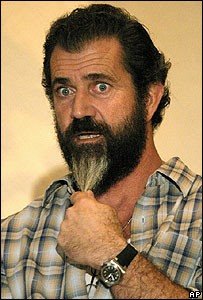
Yeah, that's Mel Gibson. This weekend he was arrested for a DUI. Apparently he was driving under the influence on the Pacific Coast Highway in California, 42 mph over the speed limit. He also reportedly wigged out on the deputies when they pulled him over and launched into a tirade about how evil Jews are, and how they are to blame for every war in history. Basically as crazy as he looks in this picture here is how he reportedly acted. He's also not contradicting reports of his crazy behavior, having released an apology today for his "horrific relapse."

I have heard some discussion of his actions, and some have referred to him as a hypocrite for doing this, considering his hyper-conservative and old-school Catholic views that presumably outlaw such things as driving drunk. It begs the question, what makes someone a hypocrite? If you have and advocate a moral code but do something that violates said moral code, does that make you a hypocrite?

A couple definitions I've found list a hypocrite as someone who advocates a view/position they do not in fact hold, or someone who puts on a mask to pretend to be someone or something he is not. I've heard the word itself comes from classic Greek plays, wherein actors were called "hypocrites" because they put on masks to become someone else. Of course a word only has the meaning we ascribe to it, but does doing something that violates your moral code make you a hypocrite?

I personally think that if someone pretends to hold a moral code, or simply says "this is wrong" or "that is wrong" with no intention that such proclamations apply to themselves, then they are a hypocrite. Hypocrite carries a lot of baggage with it - we don't like them because they are fake, they pretend to be something they aren't, they don't practice what they preach. But does that mean in order to not be a hypocrite you have to be perfect? Everybody I know that holds to some form of right and wrong has at one time or another failed to live up to their own moral code. I don't believe I know anybody who believes in such a thing as right or wrong who would claim to have never made a mistake. Does that mean everybody in the world is a hypocrite?

In one regard, I'd say yes. All of us have certain chinks in our moral armor, so to speak. Not only do we all screw up and do things wrong, but there are times when we rationalize our actions in an attempt to find a way around them being wrong. I believe that makes someone a hypocrite. Doing something wrong makes you human, not a hypocrite. If once you've made the error and either noticed it (we all have blind spots) or had it pointed out to you, you try to explain away your behavior as appropriate or find an exception you fit into, then you are being hypocritical. And all of us do this from time to time. We all have times where we are hypocritical and try to make an exception for ourselves when it comes to whatever moral code we adhere to. It would behoove us, if we do not want to be known as hypocrites, to avoid this sort of thing. I say this as someone who specializes in rationalization. Many times I have tried to find a way to make myself look more righteous than I actually am, or convince myself that I haven't actually done something wrong because of this or that mitigating factor. My guess is this is something common to many people. But I think it takes more than that occasionally happening for someone to be branded a hypocrite.

If someone is living a secret life in direct opposition to their professed moral code then they can be labeled a hypocrite. They may regret their actions but the preponderance of their choices and lifestyle would add up to, in my opinion, aggregate hypocrisy. This is the pastor who publicly decries homosexuality and abortion but pays off his mistress to get an abortion so he can save face. It took a number of choices to get to that situation. As I said we all make mistakes and just because we make mistakes we shouldn't be automatically relegated to the status of hypocrite. That being said it is fair to consider someone a hypocrite that routinely does things contrary to their professed moral code. This leads to the idea of grace.

I believe people should be shown grace when they make mistakes. If they are repentant and admit their error we should be willing to forgive them. If someone lives a hypocritical life (like the pastor mentioned above) and earned the label of "hypocrite" then if they are repentant we should be willing to show them grace and not forever relegate them to "hypocrite" status in our eyes. This display of grace doesn't necessitate a revocation of consequences, however. When we make mistakes there are certain consequences, some more severe than others. It is human to make mistakes but we cannot expect to not have to pay any consequences for our mistakes simply because we are apologetic. Someone whose license has been revoked for repeated infractions cannot expect to have their license returned simply because they're sorry. Of course they're sorry, they were caught.

Sometimes it takes being caught to show us the error of our ways, or to have someone point out our own moral inconsistencies for us to see them. I for one hope to give the benefit of the doubt to others. I want to assume they are not being hypocritical when they do something wrong, and I want to be willing and able to show grace and forgiveness when they are shown to be in error. In the same way I want to be able to receive correction when others point out my own moral failures. In the past I have had mixed reactions to being shown my own moral inconsistencies. Sometimes I react defensively, sometimes graciously - but I am always embarrassed. I never want to be a hypocrite, but I fear my status as a human being condemns me to a life of never quite living up to the standards I set for myself. I am quite thankful that God is willing to stick with me throughout this process of life and even when I make horrible mistakes and even when I act like a hypocrite, if I am willing to admit my hypocrisy and move forward He will take me forward. I hope I can show the same grace to others, and that when others share my faults with me I can hear what they're saying without being put out by their reminding me of my humanity. Above all I hope that I will never be labeled a hypocrite, though I know that it is entirely possible since I am a fallible person. The worst kind of hypocrisy would be not giving others the opportunity to make mistakes, when I myself am a mistake-making machine.